Let Convention Decide

When over 1,300 delegates gathered at the DSA’s 2025 National Convention last summer, they narrowly passed R33: Unite Labor & the Left to Run a Socialist For President and Build the Party, a resolution binding our organization to consider the endorsement of a candidate in the 2028 presidential election. One year later, the political landscape of the U.S. has shifted significantly. The Trump Administration ushered in a massive fascist escalation in repression, forcing us to respond with mass mobilization, coordinated action to protect our immigrant neighbors, and concerted efforts to win an arms embargo and end U.S. intervention in the Global South.
Our politics have resonated deeply with working class people across the country seeking a political alternative. This year has seen a significant electoral breakthrough for DSA candidates riding on the urgency of ending the genocide in Gaza, rising cost-of-living, Trump’s repression, and escalating wars, one that has grown our membership and forced us to contend with what it means to govern as socialists in different levels of government. Off this momentum, members must begin to reckon with our plans for 2028. Springs of Revolution believes that any DSA decisions on the question of presidential endorsement must be made by the highest democratic body of our organization: National Convention.
On Sunday, the National Political Committee is debating a presidential endorsement proposal put forth by the Presidential Exploratory Committee, a 6-member body composed of 2 Bread & Roses members, 1 Groundwork member, 1 Socialist Majority Caucus member, 1 Marxist Unity Group member, and 1 Red Star member. The proposal charges the sitting NPC with making a final decision on a 2028 presidential endorsement, reducing the role of the 2027 National Convention to rubber-stamping a campaign plan.
Allowing the NPC to make this consequential decision undermines our democracy and our organization’s ability to build buy-in from members for a broad, national-scale campaign. The 2027 Convention undeniably presents the most democratic opportunity to decide on existential questions facing DSA: Should we endorse anyone for President at all? Are any of the candidates sufficiently politically aligned to represent DSA on a national scale? How will we hold them accountable to our politics? Is there a more strategic intervention we could be making?
Together with comrades from Marxist Unity Group and Reform & Revolution, Springs of Revolution are submitting amendments to put the 2028 decision back in the hands of the 2027 National Convention.
A presidential campaign has the potential to irrevocably change the course of DSA’s trajectory. While a DSA-endorsed candidate may elevate our name recognition and lead to a new surge in membership, running for the highest executive office in the U.S. also carries significant risks for the organization. DSA has pulled off stunning, unpredictable upsets before: should our endorsed candidate advance to the general election and win, we would face the contradiction of a self-identified socialist at the helm of U.S. empire. With only a tiny bloc of DSA elected in Congress, a socialist president would not have a governing coalition behind them and would not be in a position to effectively resist pressure by the Democratic establishment and capital. How will we manage the fallout if our endorsed president drops bombs on the Middle East or fails to abolish ICE, lift the blockade against Cuba, and enact an arms embargo against Israel? Loss of credibility and morale amongst our base if a socialist president is unable to deliver on their promises is a major political risk that deserves serious deliberation and preparation lest it derail the nascent US left for decades to come.
If DSA members ultimately decide this risk is worth taking, the gamble should be backed by the full weight of the highest decision-making body of our organization. SOR believes the current NPC would be irresponsible to make a decision they will not be present to navigate our organization through. Convention will result in a newly elected NPC that will best represent the orientation of our rapidly growing and changing membership toward the questions of how to navigate a presidential race and its outcomes.
While we commend the base proposal for delineating a robust process of organization-wide discussion — including initial debates at the Organizing Summit and in chapters through the Member Input Question; organization-wide calls; regional discussion circles; an endorsement forum for nominated candidates; and chapter meetings to discuss and poll members on the possible candidates — this process is ultimately meaningless if it fails to provide a real basis by which any debate, forum, argument, or deliberation by members could change the pre-existing positions of the factions represented on the NPC.
Anyone who has paid minimal attention to DSA’s national politics will recognize that the positions of our highest political body, the NPC, are often entrenched. Our internal factions have political projects that they aspire to see grow in the socialist movement, and at the highest level those orientations are not often open to influence by the full membership. High-profile chapter and national leaders of Socialist Majority Caucus, Groundwork, and Carnation have already started loudly championing a DSA presidential endorsement of Alexandria Ocasio-Cortez, publicly presenting it as an inevitability to the media and in labor spaces like the 2026 Labor Notes conference — before the initial organization-wide debates even begin!
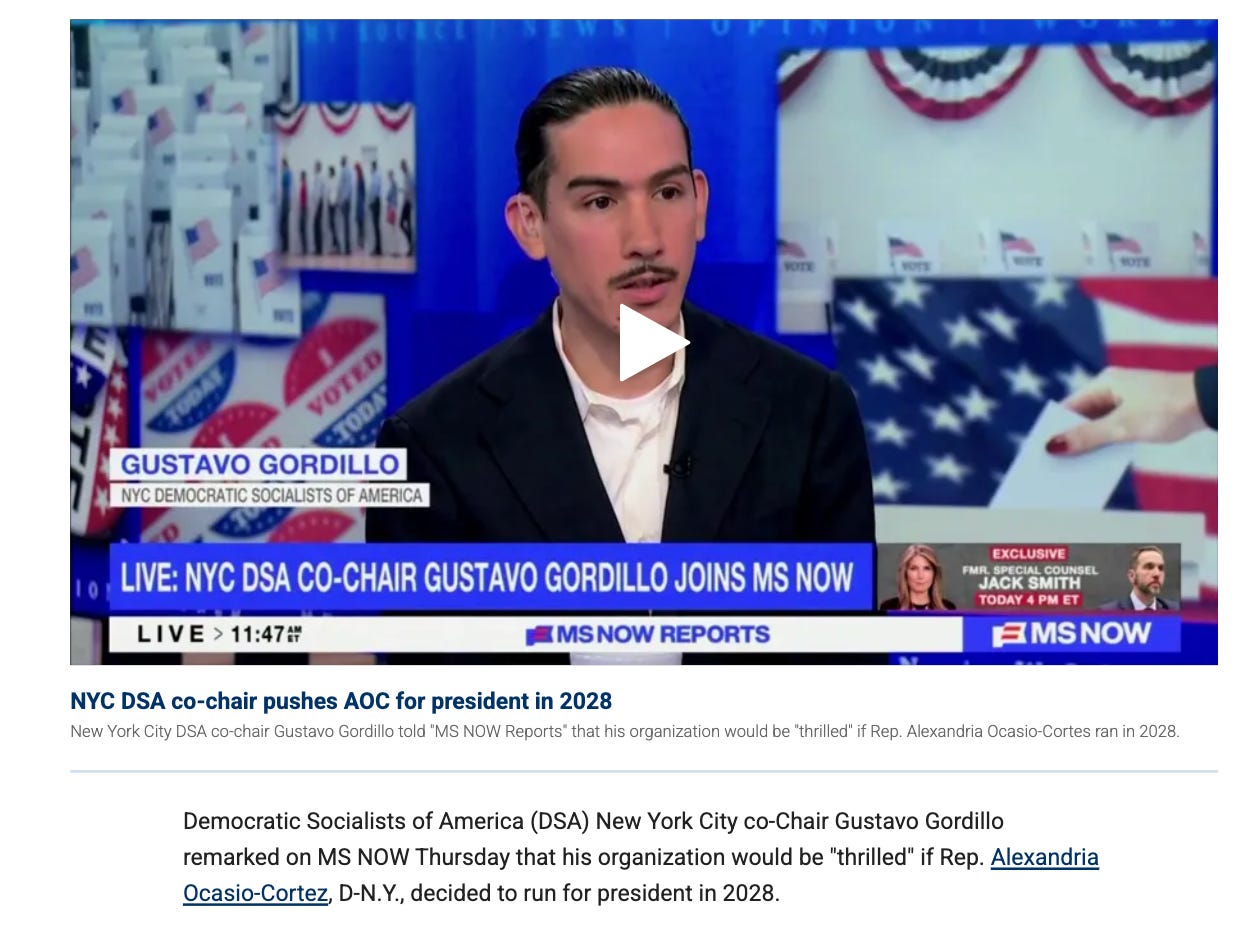
As such, we worry the “robust discussion regarding our relationship to the 2028 presidential election” outlined by the Presidential Endorsement Proposal will only serve as window-dressing for a pre-determined outcome desired by the caucuses most loudly championing this proposal. Just 14 votes are necessary to clear a simple majority on the NPC — 14 people with entrenched and long-standing opinions who will not be swayed by chapter discussions or member polls. Without a basis for deliberation among members to find and express a decision at Convention, a year of chapter debates offers only a hollow charade of participatory democracy.
The people who should be voting on a decision as consequential as a presidential campaign are the hundreds of delegates who will be entrusted and elected by their chapters to represent the diverse visions for our organization at the 2027 National Convention. Springs of Revolution believes that power must be put back in the hands of DSA’s highest decision-making body.